Thursday, October 30, 2008

Google Now Indexes Scanned Documents

Google Now Indexes Scanned Documents
by Jason Kincaid on October 30, 2008

Google has announced that it will now begin including scanned documents in its search results - a feat that requires an immense amount of processing power and advanced image recognition technology. Unlike standard text documents, scanned files don’t contain any text data that Google’s spiders can index. Instead, Google has employed Optical Character Recognition (OCR) technology, converting photos of words into digital text files.

In the past Google would attempt to index these image files as well as possible, but could typically search only file titles and nearby metadata - not the contents of the documents. From now on Google searches will include the text within these scanned images in normal search results. When you encounter a scanned document you’ll be able to view it in its original form as a PDF, or as a converted text file (click “View As HTML”).

Such technology has existed for quite a while, but accuracy has always been an issue - and the fact that Google is doing it on such massive scale makes it a very impressive accomplishment. It also opens the doors to much more thorough searching, especially for content that is often found in printed documents (like academic papers).

Here’s an example (the first result is a scanned document): Repairing Aluminum Wiring

For more, check out the announcement here.


http://www.techcrunch.com/2008/10/30/google-now-indexes-scanned-documents/

Your Business Method Patent Has Just Been Invalidated

interesting post even this is not related to internet marketing.

Your Business Method Patent Has Just Been Invalidated
by Erick Schonfeld on October 30, 2008

If you are one of the recipients of the 1,330 business method patents issued in the U.S. last year, or the thousands more that have been issued rampantly and indiscriminately over the past decade, you are probably out of luck. The U.S. Court of Appeals in Washington, D.C. ruled today that business methods are not patentable unless they meet fairly narrow rules. What this means for Internet companies and patent trolls alike is that many of their existing patents may be invalid—at least until the case is heard by the Supreme Court, assuming it is appealed.

Mike Masnick at TechDirt has a good overview of the issues in the case and the stricter rules to be applied to these sorts of patents. He writes:

The summary is that the court has said that there’s a two-pronged test to determine whether a software of business method process patent is valid: (1) it is tied to a particular machine or apparatus, or (2) it transforms a particular article into a different state or thing. In other words, pure software or business method patents that are neither tied to a specific machine nor change something into a different state are not patentable.

The most famous business method patent is Amazon’s One-Click patent, but that is not what the case was about. (It deals with a proposed patent for a method to manage the risks associated with energy cost fluctuations that was rejected). But even the validity of Amazon’s One-Click patent could be questioned if it does not meet the new test. And that would depend on what you consider to be the definition of a “machine.” Is the Amazon store the machine in question (in which case that particular patent doesn’t have any particular value beyond Amazon’s own operations), or is it any online store (in which case, it might be too far reaching)?

This ruling raises a ton of questions like that across literally thousands of patents. And it is a good thing too because business-method patents tend to be overly broad and abused.


http://www.techcrunch.com/2008/10/30/your-business-model-patent-has-just-been-invalidated/

Google Opens Up Bidding on Beer and Champagne

A major Adwords policy has been revised, and it seems to be going unnoticed. For reasons that no Googler could explain, you were unable to bid on any beer or champagne related keywords. You could, however, bid on wine keywords. This is no longer true.

According to the Google Adwords rep I spoke to on the phone yesterday, “Beer, wine and champagne may now be promoted from ad text and may be the focus of your site. We consider beer, wine and champagne to be products intended for the sale and consumption of adults. Therefore, ads promoting beer, wine and champagne will be given a ‘Non-Family Safe’ status. For information on how the family status of an ad may affect how it is served, please see Google Adwords Support.”

What about hard liquor? Nope. Still can’t bid on those terms. According to Google, “Hard alcohol and liqueurs are considered Restricted Products and therefore cannot be promoted in ad text or be the purpose of your site (occupying a significant portion of your site).

Happy bidding!

http://www.gonzo-seo.com/google-opens-up-bidding-on-beer-and-champagne/

5 Tools for On-page Image Usage Analysis

Image optimization is both vital for “search engine friendliness” and web accessibility. Let’s look at a few top tools that can help you analyze both the aspects of image proper usage:

3 out of 5 Juicy Studio Image Analyser is a handy online tool that will look at each image on a given page and evaluate the following parameters:

  • image width / height;
  • alternative text;
  • an URL to an image long description.

Juicy Studio: Image Analyser

Note that some of the “errors” found by the tool should not necessarily be corrected (e.g. very seldom an image needs a long description URL), so use it rather for informational purposes than as a call to action.

3 out of 5 Alt Text Checker (by Durham University) will list an alt text information next to each image found on the page:

Information Technology Service : Alt Text Checker - Durham University

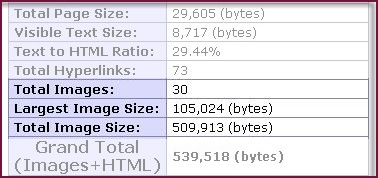
4 out of 5 Page Size Extractor will give you a quick idea of how the page images influence the page size and hence load time by giving:

  • total number of on-page images;
  • the largest image size;
  • the total image size.

Page Size Extractor - Image size analyzer

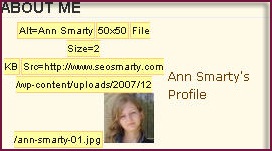
Web Developer FireFox: Toolbar offers an array of image analyzing tools:

  • display alt attributes;
  • display image dimensions;
  • display image sizes;
  • display image paths;
  • find broken images;
  • outline images missing alt attributes;
  • hide images / background images;

Web Developer Toolbar - Image Analyzer

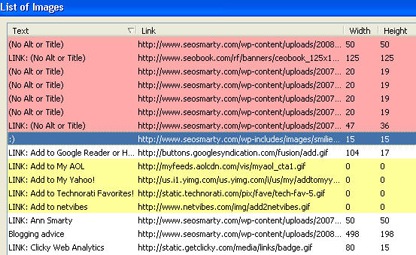
Firefox Accessibility Extension offers a most useful feature summarizing all page images in the form of a handy table (the feature can found under “Text equivalents” => “List of images“). The table is extremely easy to use as (1) it highlights “the problematic” images and (2) it can be sorted by any of the following parameters:

  • Image alt text;
  • Image source link;
  • Image width;
  • Image height;

Accessibility Extension


http://www.searchenginejournal.com/5-tools-for-on-page-image-usage-analysis/7930/

Wednesday, October 29, 2008

Why Web Design Matters

Why Web Design Matters
Oct
29

You know what would be really cool?

Your whole site redesigned in Flash!

We could really liven it up. We could do animated navigation! Edgy!

We're cutting-edge web designers. We've designed stuff that's one tons of design awards! Let's take your boring site and totally reinvent it! Make it interactive! Your visitors will love it dude!

Erm...uh-huh. Maybe not.

It's little wonder that SEOs often come into conflict with the web designers. Those designers who design-for-designs'-sake can cause serious problems when it comes to internet marketing strategy, and getting seen in search engines.

Thankfully, there are also enough good designers who do understand that web design is a balancing act.

On the flip-side, there are SEOs who underestimate the power of good design. It's one thing to get a visitor to a site, but what happens once they get there? If the visitor finds a design unappealing, confusing or lacking in credibility, they are likely to click back. The cost of not spending a few hundred/thousand dollars on good design could be significant.

If you're thinking of hiring a designer, and SEO and web marketing is important to you, then you need to make sure they follow a few guidelines. Here's a checklist that will help you and your designer come up with the ultimate, well-crafted design that both appeals to your visitors, and complements your marketing efforts.

The point of synergy between SEO and design lies mostly in structure.

1. Purpose/Know Your Audience

The first, and by far the most import aspect of web design, is to clarify the purpose of the site.

Write down these three questions, and answer them in as much detail as you can.

  • Who will use the website?
  • What will people use the website to do?
  • How will people find the website?

Who Will Use The Website?

The "who" question is about meeting expectations.

If your audience are tree-huggers, they aren't going to respond to a slick, corporate site. It's like wearing a suit to an interview for a pool-guy position - the image doesn't fit the purpose.

Put yourself in the users shoes. What are their likes? Dislikes? What type of language do they use? How old are they? What is their demographic? Are they web-savvy? Can they read small fonts? Write down as many characteristics as you can in order to build up a profile of your user base.

When you first visit a competitor site targeting your audience, what attracts to you to it, and what annoys you? Why? What are your expectations?

Your site must reflect the values, needs and desires of your target audience.

Let's take a look at a couple of examples where the designer has got this right:

Smashing Magazine

The audience are web designers. People who are visually-oriented. People who want news about the latest trends and techniques. The design and format reflects these values and desires. It is based around large, bright attractive visuals. Text is kept to minimum. Smashing Magazine uses a blog format to facilitate the dissemination of news. All other functions are relegated.

UseIT

The audience for this site are people interested in usability, in particular, the writings of Jakob Nielsen. Nielsen has strong, and often divisive, views about the role of simplicity in web design. Some may say the site is not designed at all, but they'd be wrong. The site is Nielsen's theories and agenda made form. The design reinforces the idea that structure is more important than gloss.

What Will People Use The Website To Do?

What is the primary function of your site? The function needs to be crystal clear. What do you want users to do? Do you want users to sign up and discuss topics? If so, then you need to orient your design around serving that function. The layout, the graphics, and the text should all encourage a user towards taking that action. Relegate all other design aspects to secondary status. If the design gets in the way of a user completing that function, it isn't good design, no matter how pretty it looks.

How Will People Find The Website?

How the user will find the website is often overlooked be designers.

If visitors are going to use a search engine to find your site, then your site must be oriented around SEO. That means fast, crawlable, and content rich.

If users find your site because they are already aware of your brand, then seo considerations may be less important. The user merely needs to be assured they've arrived at the right site. Such sites usually put heavy emphasis on branding.

Will most of your uses find you via StumbleUpon? Again, there are design features that appeal to this audience.

2. Visual Culture

This is a summary for a course offered by the University Of Wisconsin. It sums up the nature of our visual culture well:

Ours is a visual culture. Our workplaces are visually saturated environments and our dominant pastimes (films, television, video games, and the internet) are visual media. Moreover, we communicate visually when we are trying to cross over cultural boundaries; think, for example, of the graphics devised for international signage. Knowledge is often communicated visually: scientists chart brain activity, economists graph fiscal trends, geographers map territory and detectives photograph evidence. The growth of the web as an information distribution system has made an understanding of visual design factors indispensable in every field of study. The visual also our access to the past. The earliest recorded communications are pictorial and artifacts are central to the reconstruction of history

This is where both the graphical element of web design, and spacial relationships on the page itself, play a significant role.

Graphics convey meaning in different ways to text. The saying "a picture is worth a thousand words" is apt here. Ensure your graphics reinforce the values and needs of your audience. Make sure the graphics help people, not hinder them. Too often, graphics are self-consciously used to impress.

Obviously, web design is not just about appropriate and pleasing graphics. It's also about form, and that includes text. What do you feel when you see a huge block of text in tiny print? Most people feel that, hey, this is work!

Spacial considerations are an important way to convey meaning, and also useful for SEO. Split pages up into headlines and short paragraphs. This technique serves two purposes. You can include extra keywords in heading tags, and you can focus attention where it needs to go. When people arrive at your site via a search engine, they will scan your page for their keyword phrase. Make sure they find it quickly and easily.

3. Clarity

Your website doesn't exist in isolation. How often do you glance at a website before clicking back or retyping your search query? Do you spin your scroll wheel immediately after arriving at a site, scanning for the exact information you require? No doubt you do it hundreds of times a day. Chances are, so does everyone else.

Therefore, clarity, both visually, and in terms of conveying meaning, is very important. If you can't convey to a visitor "you've found the right place" quickly, then you run the chance of losing that visitor.

All the linking and SEO in the world won't solve that problem.

4. Crawlability

Obviously, a website that can't be crawled is invisible to the search engines. Include a Google Site Map, and make your navigation text based, where possible. If you must use scripted links, then duplicate the navigation for crawlers. No matter what some designers might say, navigation is not the place to get funky. It's the place to get simple.

Consider cars. If you drive one car, you can drive them all. Why? The controls are all in the same place. Car designers don't get funky with the main control mechanism. The same goes for websites. Where navigation is concerned, stick to convention.

Personally, I'd avoid any designer who tries to get clever with navigation. They don't understand the web.

5. KISS

If faced with a design decision, go for the simple over the complex.

The web favors simplicity.

It's the nature of the beast.

6. Branding Is The Experience

Brand is often thought of purely in terms of identity. But this is an oversimplification.

Take, for example, McDonalds.

If people were asked to think of the brand of McDonalds, they'd think of the big, stylized letter "M". Or Ronald McDonald. But the McDonalds brand is made up of much more. The McDonald's brand is about fast service. It's about cheap food. It's about generic, yet tasty food. It's about the layout of the store. Every aspect of McDonald's store design and process is rolled into the brand. It's the entire experience. The M is really just a badge.

It's the same with websites. The brand isn't the graphical logo. The brand is the speed your pages load at. The clear layout. The ease of navigation. The tone of your writing. The fact you answer queries quickly. The fact it's easy to contact you in the first place. Your web design must not get in the way of these aspects. It must complement and reinforce them.

7. Speed

Your pages must load as fast as your visitors expect pages to load. And these days, that means Google fast! If need be, sacrifice graphics and features for speed. Speed is not just important. Speed is everything. It is too easy for a visitor to click back.

8. Read Point 7 Again

Really important. Really :)

9. Conflicting Agenda

One conflicting agenda between designers and SEOs often has to do with style over substance.

The main point of this post is to reinforce the idea that substance and style are inseparable. Both designers and SEOs must find a middle ground in order to arrive at one goal: a successful site. Avoid designers whose aim is to win awards, unless of course, winning design awards is part of your marketing strategy. The designers agenda should closely match your own.

10. Design Is Mostly About Structure

I was having a chat recently with a web designer who has formal graphic design qualifications, has won Webby Awards, runs his own web design shop employing 50 people, and has worked on multi-million dollar web projects. He's come round to admitting - very reluctantly - that on the web, graphic design doesn't really matter much. The design is mostly about structure. The information flow. Facilitating the interaction.

And he's right.

What we've often come to think of as design is more than just graphics and appearance. That's the icing. Design is about facilitating a process. It's about the way people move around and follow steps. A web site that makes that process complicated will not work, no matter how good the presentation.

A good designer will understand this.

Many do.


http://www.seobook.com/why-web-design-matters

Internal Links - Only The First Link Counts in Google?

I thought I would share the results of another simple test I did to see how Google treats internal links.

What does Google count, when it finds two links on the same page going to the same internal destination page.

I surmised:

  1. Google might count one link, the first it finds as it indexes a page
  2. Google might count them all (I think unlikely)
  3. Google might count perhaps 55 characters of ALL of the available links (could be useful)

OK - From this test, and the results on this site anyways, testing links internal to this site, it seems Google only counted the first link when it came to ranking the target page.

In much the same method as my recent seo test where I tested how many words you should put in a link, I relied on the “These terms only appear in links pointing to this page” (when you click on the cache) that Google helpfully shows when the word isn’t on the page.

Again, I pointed 2 everyday words at a page that don’t appear on the page or in links to the page, and searched for the page in Google using a term I knew it would rank high for (Shaun Anderson) and added my modifier keywords. I left it for quite some time, and checked every now and again the results.

Google Cache

Searching for “shaun anderson” + “Keyword 1″ returned the page (cache shown above).

Cartoonist

Searching for the term “shaun anderson” + “keyword 2″ did not return the page at all, only the page with the actual link on it, further down the SERPS.

Fireman

Not even in a site search.

Site Search

It’s not exactly Google terrorism to identify this, so here is the actual test page where you can see the simple test in action.

So today :) on this site :) in internal links :), Google only counted the first link as far as anchor text transfer is concerned :)

How you can use to your advantage?

  1. Perhaps, you could place your navigation below your text
  2. This lets you vary the anchor text to important internal pages on your site, within the text content, instead of ramming down Google’s throat one anchor text link (usually high in the navigation)
  3. Varying anchor text naturally optimises to an extent the page for long tail ‘human’ searches you might overlook when writing the actual target page text
  4. Of course, I assume links within text surrounded by text are more important than links in navigation menus
  5. It makes use of your internal links to to rank a page for more terms, especially useful if you link to your important pages often, and don’t have a lot of incoming natural links to achieve a similar benefit

Long Tail SEO

Credit - Graphic first sourced at Search Engine Land and created by Elliance, an eMarketing firm.

Works for me anyways, when I’m building new sites, especially useful on longtail searches, and there’s plenty of editorial content being added to the site for me to link to a few sales pages.

Note: I would think Google would analyse everything it finds, so it would find it easy to spot spammy techniques we’ve all seen on sites trying to force Google to take multiple link anchor text to one page.

What do you think?

If you like this test, you might like;

  1. Limit Anchor Text Links To 55 Characters In Length?
  2. Will Google Rank Pages Better With Valid Code?
  3. How Many Words Will Google Count In The Title Tag?
  4. A Google Friendly Website Navigation System
  5. Do It Yourself Search Engine Optimisation
rated 5.0 by 6 people [?]
You might like:


http://www.hobo-web.co.uk/seo-blog/index.php/1st-internal-link-counts/

Tuesday, October 28, 2008

Ten Comments You Think Are Cool And Insightful But Aren’t

May not be internet marketing related, but very interesting post.

Comments are the lifeblood of TechCrunch, and we love ‘em. But we also get our share of the freaks, conspiracy theorists and jerks out there who have something to say and believe they have a constitutional or God given right to say it, right here. The author thinks they’re funny and insightful, but when we see the same comment over and over (and over) again, we fail to laugh.

Ten of our least favorite comment types are below. Which one are you?

  1. “Slow news day?” - Typically left on stories that the reader thinks are boring, not newsworthy or off topic. A recent example is the Britney on Twitter story - early on someone made this insightful comment and the story ended up with 112 comments. This comment is left at least once per day on some story, and usually multiple times per day. We usually delete them.

    We haven’t had a slow news day at TechCrunch, ever. I always have a list of ten or more posts to write, and am just looking for the time to get to them. If a story is on the site, it means we want it to be there.

  2. “TechCrunch is really going downhill lately.” - First left in 2005, a couple of months after the blog launched. Seen daily since then.
  3. [random trolling, often with a wish that we'd die or are unethical in some way] - We get lots of these, and delete as many of them as we can. But first we check the IP address against previous comments left on the site. About once a month we see a really nasty anonymous comment that’s left by an IP address that had always been used by a single named commenter before that. Most of the time we had just posted a critical review of the person’s company right before the comment was left.

    We don’t publish the real names of these people, but I do keep a list of people that seem to be really disturbed in some way. It’s often funny to see them at an event, acting like they really think TechCrunch is great.

    If you are going to say something nasty, use your real name or learn about the magic of proxy servers

  4. SoAndSo already did this” - A comment left when the reader believes that the new service we are describing is not a new idea, and therefore shouldn’t be given any attention. The problem is that there is very rarely a brand new idea. Instead, most of the products we review are iterations on what’s come before. And sometimes a new product tries to tackle the same problem that someone else has in a new way.

    While it’s worth pointing out other products that are similar or relevant to new ones, it isn’t interesting to simply suggest they are a copycat of something else. If we’re covering it, we think it’s interesting or unique in some way.

  5. “Nice journalism…where’s the balance?” This comment, which comes in many forms, criticizes us for writing a one-sided story. People are used to reading old media, where journalists don’t write their opinions. Instead, they get sources to say what they want. I’ve seen this first hand - being interviewed for half an hour or more on a topic and then seeing a single, misleading quote in the finished product.

    We don’t strive to be balanced. We strive to be correct. And we don’t try to trick the reader by making them think some source said something they really didn’t.

  6. “How much did the company pay you to write this post?” This is a conspiracy theory comment, bred in the minds of people who only see evil in the world. Think through this for a moment…if we ever asked for or received payment for a post, how long would it take for someone to talk? We are stubbornly independent, and our opinions are our own. If someone offered to pay us for a post, we’d just publish the offer immediately and humiliate the company.

    When it comes to advertisers, we have a strict ethical wall between sales and editorial, just like “real” media. You can buy ads all you like on TechCrunch, but it won’t get you editorial coverage.

  7. “What’s your problem with [Company X]“ - Often left when we critically cover Yahoo, Microsoft, AOL or Google. Most recently it’s been Yahoo, which has been mismanaged beyond negligence this year. These comments are particularly funny when its alter ego (see immediately below) is written after a positive story on the same company.

    I write what I think, and then I write why I think it. If you disagree, great. But that doesn’t mean there is a conspiracy theory to trash a company unfairly.

  8. “You are such a Yahoo/Microsoft/Google/AOL shill.” - This is Yin to no. 7’s Yang. What’s really entertaining is watching the comments on a negative post on a company and seeing something like this, when a day or two earlier the opposite comment was left on a positive post about the same company.
  9. “I hope you die/I’m going to kill you” - These comments happen more often than you’d think. More on that in a later post. In one awesome example we got a non-anonymous death threat from a startup engineer. When I sent it to the CEO, he said “ah, that’s just him, he’s a little strange. Hey, when are you going to cover our new product?” To this day we haven’t mentioned that startup again on TechCrunch. There are lines that shouldn’t be crossed, and threatening to kill any of our writers, my dog, or my family is one of them.
  10. “Unsubscribed!” - A comment left after we’ve expressed an opinion counter to what the reader believes. Saying they are unsubscribing is their way of showing that they think we deserve a decline in readership. Our counter is to ban certain readers, most of whom get apoplectic and fail to realize that we have no way of stopping people from reading the site’s content.

    We can live with a few readers unsubscribing out of anger from time to time, it shows we’re at least keeping things interesting. If you really think we’re derailing, leave a reasonable comment saying why you think so. We listen closely to those.

Bonus: “You deleted my comment!” - left after someone has said something spammy, hateful or ridiculously stupid. The reader then comes back and complains that we’ve violated their right to free speech and are censoring them. Besides the fact that they’ve confused us with the U.S. government and their constitutional rights, they’re generally unwelcome and quickly get an IP block.


http://www.techcrunch.com/2008/10/28/ten-comments-you-think-are-cool-and-insightful-but-arent/

Ballmer Email: Microsoft Is Really Sticking To “Software Plus Services” Message

Microsoft CEO Steve Ballmer sent an email to customers today (reprinted below) summarizing some of the big news coming out of the Professional Developers Conference (PDC) in Los Angeles. He talks about both the Azure cloud services platform (a comprehensive set of storage, computing, and networking infrastructure services) as well as Office in the browser.

The email reiterates Microsoft’s core messaging that the Internet is fine, but it needs a little desktop software to really make it hum: “the key to delivering value today and in the future lies in combining the best aspects of software running on PCs, servers, and devices with the best aspects of services running on the Web-an approach we call “software plus services.”"

Client software is needed, he argues, to take full advantage of the hardware on devices. Multicore processors and new programming languages will expand computing capabilities, he says, and “the interactive experiences that people expect on their PC, mobile phone, and media player depend on sophisticated software running on powerful processors”:

In other words, software does the heavy lifting, and the browser makes access and communication easy: “For the Web, it’s the ability to bring together people, information, and services so we can connect, communicate, share, and transact with anyone, anywhere, at any time.”

The full email is below. What Ballmer says makes sense. But Microsoft also has a huge stake in software, since it powers more than 100% of their profits. If he’s betting correctly, Microsoft can dominate another generation of computing. If not, Google eats their lunch.

Or maybe Google is thinking the same way…as they expand the functionality of Gears ever further, Google is also saying they need a direct tie to the hardware on a PC to really make their services sing.


—–Original Message—–
From: Steve Ballmer
Sent: Tuesday, October 28, 2008 2:37 PM
To:
Subject: A Platform for the Next Technology Revolution

During the past decade, a dramatic transformation in the world of information technology has been taking shape. It’s a transformation that will change the way we experience the world and share our experiences with others. It’s a transformation in which the barriers between technologies will fall away so we can connect to people and information no matter where we are. It’s a transformation where new innovations will shorten the path from inspiration to accomplishment.

Many of the components of this transformation are already in place. Some have received a great deal of attention. “Cloud computing” that connects people to vast amounts of storage and computing power in massive datacenters is one example. Social networking sites that have changed the way people connect with family and friends is another.

Other components are so much a part of the inevitable march of progress that we take them for granted as soon as we start to use them: cell phones that double as digital cameras, large flat-screen PC monitors and HD TV screens, and hands-free digital car entertainment and navigation systems, to name just a few.

What’s missing is the ability to connect these components in a seamless continuum of information, communication, and computing that isn’t bounded by device or location. Today, some things that our intuition says should be simple still remain difficult, if not impossible. Why can’t we easily access the documents we create at work on our home PCs? Why isn’t all of the information that customers share with us available instantly in a single application? Why can’t we create calendars that automatically merge our schedules at work and home?

This week at the Professional Developers Conference (PDC) in Los Angeles, we shared news with software developers about a new set of platform technologies that will help transcend these limits. Because you are a subscriber to Executive Emails from Microsoft, I wanted to share my thoughts about the impact that these technologies will have as developers begin to use them to create a new generation of experiences that extend uninterrupted from the desktop to the mobile phone, media player, car, and beyond-to places where we never thought information and communications would be available to us.

A NEW PLATFORM FOR CLOUD COMPUTING

At PDC, we announced the availability of an early preview release of a new technology called Windows Azure. Windows Azure will enable developers to build applications that extend from the cloud to the enterprise datacenter and span the PC, the Web, and the mobile phone. For the first time, we shared pre-beta code for Windows 7 and for Windows Server 2008 R2. Windows 7, which is the next version of the Windows desktop operating system, will take advantage of software and hardware advances to help eliminate the boundaries between information, people, and devices.

We also previewed Office Web applications, which are light-weight versions of Word, Excel, PowerPoint, and OneNote that are designed to be accessed through a browser. Office Web applications will be part of the next version of Office and will enable people to view, edit, and share information and collaborate on documents on the desktop, the phone, and in a Web browser in a way that is consistent and familiar.

Windows Azure is part of the Azure Services Platform, a comprehensive set of storage, computing, and networking infrastructure services that reside in Microsoft’s network of datacenters. Using the Azure Services Platform, developers will be able to build applications that run in the cloud and extend existing applications to take advantage of cloud-based capabilities. The Azure Services Platform provides the foundation for business and consumer applications that deliver a consistent way for people to store and share information easily and securely in the cloud, and access it on any device from any location.

Windows Azure is not software that companies will run on their own servers. It’s something new: a service that runs in Microsoft’s growing network of datacenters and provides the platform that helps companies respond to the realities of today’s business environment, and tomorrow’s. Windows Azure technologies are already finding their way into products such as Windows Server 2008 and System Center Virtual Machine Manager, enabling organizations and Microsoft partners to create their own cloud infrastructure.

Windows Azure will enable organizations to respond to realities such as the need to use the Web to provide customers with comprehensive information and to interact with an audience that has the potential to expand exponentially overnight; to integrate operations with partners-and sometimes even competitors-to meet customer needs; to add new capabilities quickly to respond to new opportunities; and to enable employees to work efficiently and effectively no matter where they are. These realities apply not just to businesses, but to organizations of all kinds: schools, governments, community groups, and more.

Traditional approaches to building technology infrastructure and delivering computing capabilities make it difficult and expensive to adjust to these realities. You need systems with enough capacity to meet the highest possible demand-capacity that includes servers and buildings to house them, the power to run them, and the people to manage them. You have to spread that capacity across locations so there’s a backup if one part fails. You have to solve issues like access for different types of users and compliance with tax regulations in all countries where your customers reside.

Designed specifically to meet the global scale that today’s organizations require, the Azure Services Platform will provide fundamentally new ways to deploy services and capabilities. It gives businesses the option to take advantage of the capacity available in the cloud as it is needed, reducing the need to make large upfront investments in infrastructure simply to be ready when demand spikes. It will enable developers to create applications that run in the cloud and provide the features, information, and interactivity that employees, partners, and customers expect-no matter how many of them there are, where they are in the world, or what device they have at hand.

SOFTWARE PLUS SERVICES AND THE POWER OF CHOICE

The Azure Services Platform reflects our belief that choice is critical for developers, companies, and consumers. It is also based on our belief that the key to delivering value today and in the future lies in combining the best aspects of software running on PCs, servers, and devices with the best aspects of services running on the Web-an approach we call “software plus services.”

Our software plus services approach lets people take full advantage of the incredible power of today’s devices. While there are undeniable benefits to being able to tap into the wealth of information and services that can be accessed over the Web through a browser, the interactive experiences that people expect on their PC, mobile phone, and media player depend on sophisticated software running on powerful processors.

The richness of these experiences will only increase as multicore processors expand the computing capabilities of our devices and new programming languages open the door to a new generation of applications that let us use more natural ways to interact with digital technology such as voice, touch, and gestures.

Software plus services also recognizes that for most companies, the ideal way to build IT infrastructure is to find the right balance of applications that are run and managed within the organization and applications that are run and managed in the cloud.

This balance varies by company. A financial services company may choose to maintain customer records within its own datacenter to provide the extra layers of protection that it feels are needed to safeguard the privacy of personal information. It may outsource IT systems that provide basic capabilities such as email.

This balance will change over time within an organization, as well. A company may run its own online transaction system most of the year, but outsource for added capacity to meet extra demand during the holiday season. With software plus services, an organization can move applications back and forth between its own servers and the cloud quickly and smoothly.

Today, companies around the world are implementing Microsoft technologies to take advantage of the best combination of on-premise software and cloud-based services. Using Microsoft Online Services, businesses including Coca-Cola Enterprises, Blockbuster, and Energizer access and manage Microsoft Exchange, SharePoint, Office Communications Server, and Live Meeting over the Web through a single, secure infrastructure. In addition, 1 million people rely on Office Live Workspace for sharing and collaborating with friends, family, and colleagues.

EXPANDING THE DEFINITION OF PERSONAL COMPUTING

Ultimately, the reason to create a cloud services platform is to continue to enhance the value that computing delivers, whether it’s by improving productivity, making it easier to communicate with colleagues, or simplifying the way we access information and respond to changing business conditions.

In the world of software plus services and cloud computing, this means extending the definition of personal computing beyond the PC to include the Web and an ever-growing array of devices. Our goal is to make the combination of PCs, mobile devices, and the Web something that is significantly than more the sum of its parts.

The starting point is to recognize the unique value of each part. The value of the PC lies in its computing power, its storage capacity, and its ability to help us be more productive and create and consume rich and complex documents and content.

For the Web, it’s the ability to bring together people, information, and services so we can connect, communicate, share, and transact with anyone, anywhere, at any time.

With the mobile phone and other devices, it’s the ability to take action spontaneously-to make a call, take a picture, or send a text message in the flow of our activities.

Through Live Mesh-a service from Microsoft that we announced earlier this year and about which we shared new information week-we’re beginning to bridge the PC, phone, and Web and create this next generation of connected experiences. Built on the Azure Services Platform, Live Mesh enables you to use programs and information stored on your work computer from your home PC, and vice versa. With Live Mesh, you can share folders and ensure that the information is automatically synchronized across your devices.

Live Mesh hints at how our lives will be transformed as the barriers between devices disappear and the option to connect instantly to people, devices, programs, and information becomes a reality.

We’re not quite there yet. Today, the Azure Services Platform is available only as a limited technology preview release. But as developers begin to combine the capabilities of this new platform with the amazing ongoing hardware and software innovations that we are seeing from companies across the industry, it will bring us significantly closer to the time when information, communication, and computing flows along with us seamlessly as we move through our day-to-day activities.

You can learn more about these technologies and the progress we are making by visiting the Microsoft Software + Services Web site at http://www.microsoft.com/softwareplusservices/.

I look forward to sharing more information with you about these new technologies in the near future.

Steve Ballmer


http://www.techcrunch.com/2008/10/28/ballmer-email-microsoft-is-really-sticking-to-software-plus-services-message/

Monday, October 27, 2008

Yahoo: Now you can geo-target users at country, city or ZIP code level

From Yahoo's official blog:

You Can See Them From Here

Now you can geo-target users at country, city or ZIP code level

Where are your people? And more importantly, are they finding you? Knowing your ads show up for the right people in the right places is crucial, especially when your business only caters to a specific area. You may already be familiar with geo-targeting, but now there are new ways to customize your targeting, whether you’re reaching for the whole country or want to pinpoint a city or ZIP code.

Geo-targeting is a clever little feature that can analyze a user’s search query, their Internet Protocol (IP) address and other user information to determine where they are and what ads to serve to them. For example, if you select Portland as a geo-targeted region for the sale of your product, searchers with an IP address in Portland will be served your ad. If you’re a Portland business, you’re likely to get more relevant clicks that can lead to more sales. Our new updates give you the chance for even more relevant clicks.

Coast to coast
While geo-targeting is usually seen as limiting your area to fewer clicks, one new geo-targeting feature can actually bring you more traffic. If you were trying to reach United States customers before, your choices were either to select the entire market — both the U.S. and Canada — or individually select each of the 50 states. (Oh, and the District of Columbia. How could I forget you, D.C.?)

Not only is that a pain, but selecting individual states can leave traffic out. There is a good number of Internet users whose IP addresses suggest they are located within the U.S., but are not easy to pinpoint to individual states you’ve selected. Since geo-targeting is designed to show your ads to users our system recognizes as located within your geo-targeted areas, in the old system those users might not have seen your ad.

Getting local
Up until recently, the geo-targeting functionality was built around Designated Marketing Area (DMA), regions determined by Nielson Media Research, Inc. (yes, the Nielson group who conducts the TV ratings surveys). However, some advertisers need even more focus, especially in more populous regions. Yahoo! now lets you zoom in on targeted cities and, in a beta feature, ZIP codes as well.

You will find geo-targeting when you sign up for your account online, but you may go back in and change your scope at any time. To do this, select “Geo-Targeting” under your Campaigns tab in your account.:

- Click the “Campaigns” tab.
- Choose a campaign.
- Click the “Campaign Settings” drop-down located in the upper right-hand corner (above the graph).
- Select “Geo-Targeting.”

From there you can use the pulldown to select your target area by Entire Market, Country, State/Province, DMA , City or ZIP code. A map will provide a visual of the areas you are selecting.

To narrow your scope further, try our ZIP code feature, currently in beta. First, select ZIP/Postal Code from the pulldown. From here you may type in the ZIP codes of the areas you want to serve, and use the Search button to confirm where the ZIP codes you’ve selected are located. You can also use the dynamic map to zoom in and out and find more ZIP codes within your area if you don’t know them all offhand.

How tight is too tight?
Keep in mind the more you target, the fewer users your ads may reach. Generally, you’re trading relevancy for volume, narrowing your target to a specific audience rather than every potential eyeball in the overall market. For example, if you service a small area and only choose five ZIP codes, you are likely to receive a limited number of clicks from people in those targeted areas who are searching for your products. We recommend choosing a minimum of 10 ZIP codes to broaden your scope.

You can also opt not to use geo-targeting by de-selecting all geo-targeting settings within your account, and your ads will be eligible for display to the entire U.S./Canada market. This may work for those who will ship products anywhere or who want to utilize the ability to get their brand name in front of as many users as possible.

Our new geo-targeting system is designed to help you hit the bullseye with your ads every time!

—Kastle Waserman, Communications Manager


http://www.ysmblog.com/blog/2008/10/20/you-can-see-them-from-here/

IM Broadcast: “YouTube For Internet Marketers”

Our friends, Loren Baker, David Snyder & Jordan Kasteler have launched a new video site named IM Broadcast. IM Broadcast, as Loren describes it, is “YouTube for Internet Marketers.”

In short, it is a video sharing site focused around the Internet Marketing industry. The focus is not just to upload videos on Internet marketing topics, but to also create a social networking site around those videos.

Why not for our industry? We already have dozens and dozens of discussion forums, we have our own Sphinn site and we have WebmasterRadio.FM as our radio site.

IM Broadcast will be live streaming portions of the first Scary SEO conference, as a way to kick things off for the site.


http://searchengineland.com/im-broadcast-youtube-for-internet-marketers-15232.php

AmazonのWindowShopは、オンラインメガストアのおしゃれなインターフェース

Amazonは本日(米国時間10/27)、新しい店頭インターフェース、WindowShopをオープンした。これは、Amazonの新作や人気の映画、本、ビデオゲーム等を、オンラインメガストアのウィンドウショッピングを楽しくするべく作られたものだ。各商品は大型の格子状に並べられたタイルで表示され、それをユーザーが気に入ったものが見つかるまでめくって探していく。

このサイトは、何となく何かを探している買い物客を対象に作られているとみえ、検索機能はない。サイト内を移動するには矢印キーを使い、スペース キーを押せば個々の商品にズームインできる。各商品にはデモデビオ(映画、音楽、ビデオゲームの場合)または抜すい(本の場合)が用意されている。

これは、iTunesなどと同じように特にあてがなくてもユーザーが見て回りたくなる魅力的オンラインインターフェースの答えのひとつなのだろう。 Amazonでは、およそありとあらゆる物を売っているが、巨大な品揃えに客が圧倒されかねず、欠点にもなっている。iTunesと違い、私は「見て回 る」だけのためにAmazonを訪れたことは一度もない。

WindowShopはいじっていて楽しいが、何かナビゲーション的なものもあるべきだ(例えば、本だけを探すとか)。楽しさの要因のひとつが商品との偶然の出会いであることはわかるが、現段階でこのサイトは、目新しいだけで、定期的に訪れる場所ではないという感じだ。


http://jp.techcrunch.com/archives/20081027amazons-windowshop-offers-a-sleek-interface-for-the-online-megastore/

New Yahoo Developer Tools Coming Tomorrow

New Yahoo Developer Tools Coming Tomorrow

by Mark Hendrickson on October 27, 2008

Last week Yahoo invited a group of reporters to its Brickhouse offices in San Francisco to discuss its open strategy in general and to announce that a set of new developer tools were coming in the following week.

Well, it’s that following week and we just received word that these tools go live tomorrow morning. Yahoo will provide details at that point in a blog post, but from what we learned last week, we can expect a sandbox for developers to start building social applications (based on the Open Social spec) that can later be placed across Yahoo’s properties.

These properties include My Yahoo, profile pages, and the Yahoo homepage itself, among other locations. There will also be a “data updates” system that pushes social notifications around from website to website (much like Facebook Beacon, except more extensive), as well as an API that lets developers pull Yahoo profile data onto 3rd party sites (much like Facebook Connect).

Expect documentation for all of this to get released here.

Tuesday, October 21, 2008

SEOMOZ's

SEOMOZ's new tool Linkscape is the hottest topic on Sphinn right now. Linkscape gathers information from people's websites. The topic so hot right now because it is considered as "stealing" by many webmasters.

Aaron Wall: SEOmoz's Linkscape: Why the Backlash is Overblown


Crawling vs. Indexing

How To Add 7 Billion Pages To Your Index Overnight

Can I Get Out Of SEOmoz's Linkscape Or Not?

How To Block The Bots SEOmoz *Isn't* Telling You About

Layoffs, layoffs, and more layoffs!!!

Confirmed: Wikia Cuts 10% Of Workforce
http://www.techcrunch.com/2008/10/20/wikia-rumored-to-cut-30-of-workforce/

Yahoo Layoffs Expected to Hit This Week
http://www.techcrunch.com/page/2/

Some Of These Layoffs Aren’t Really Layoffs
http://www.techcrunch.com/2008/10/17/some-of-these-layoffs-arent-really-layoffs/

13 Employees Laid Off At VoIP Startup Jaxtr
http://www.techcrunch.com/2008/10/17/13-employees-laid-off-at-voip-startup-jaxtr/

Keeping Count: The TechCrunch Layoff Tracker
http://www.techcrunch.com/2008/10/17/keeping-count-the-techcrunch-layoff-tracker/

25% Layoffs At Seattle’s Zillow
http://www.techcrunch.com/2008/10/17/25-layoffs-at-seattles-zillow/

More Layoffs: Pandora Cuts 14 Percent of Its Staff
http://www.techcrunch.com/2008/10/17/more-layoffs-pandora-cuts-14-percent-of-its-staff/

Thursday, October 16, 2008

Top 10 Social Bookmarking Sites

Keep in mind that all 10 sites are dominated by male users.


The number of social bookmarking sites has exploded in the last year, leaving someone new the space probably a bit overwhelmed at where to start. If you are new to social networking understand that each social networking site is different, it attracts a different audience with different interests. Thus what interests someone on Reddit might not appeal to anyone on Digg.

So who are the main players in the social bookmaking space? And what is the profile of the typical user of these social bookmarking sites? The answers below might surprise you!

Digg.com
Digg is the most popular and notable of the social bookmarking sites. Quantcast estimates that that Digg has about 25 million unique visitors a month. The audience is predominantly male (65%), between 25-34 years of age, with a household income between 30k and 100k. Digg’s demographics have changed as it has become more popular (mainstream). Not to long ago the Digg profile was male, under 25 who made less than 30k a year. Social media topics that do well on Digg include interesting photos, anything anti-Microsoft and lists (top 10, etc).

Propeller.com
Propeller (formely Netscape) is comfortable the second biggest social bookmarking site behind Digg with over 5.8 million monthly uniques, of which 3.6 million (62%) are in the U.S. Netscape also attracts a male biased audience (54) , that is slightly older (45-54 is biggest age group), and 55% of Propeller.com visitors have an household income over $60k.

StumbleUpon
Stumbleupon.com reports over 4.5 million members and Quantcast classifies it as a top 5,000 site that has about 1.5 million unique visitors a month from the U.S. The audience is male biased (56%) and between the ages of 45-54 (22% of visitors). The older demographic also skews the household income with 51% of visitors having a household income of over $60k.

Reddit.com
Reddit is becoming a very popular social bookmarking site with about 1.2 million unique visitors in the U.S., making it slightly larger than Del.icio.us. Reddit attracts a predominantly male (57%) audience that is between the ages of 35-44 (25%). With 65% of the audience having a household income of between $30 and $100k, Reddit is a mainstream social networking site. As a result, political, environmental, business and entertainment news does well with this audience.

Del.icio.us
Del.icio.us is the oldest social bookmarking site and Quantcast classifies it as a top 5,000 site that gets about 1.1 million unique visitors a month from the U.S. The audience is male (53%) and about 47% of them are over 45. Similar to StumbleUpon, 51% of visitors having a household income of over $60k.

Newsvine.com
Newsvine is a top 10,000 site that reaches over 362K U.S. monthly uniques. The site attracts a slightly male slanted audience (54%) and 51% of the users have a household income under $60k.

Fark.com
Fark.com is a much more trafficked site than people expect. With 1,972,698 monthly unique visitors in the U.S., it is bigger than StumbleUpon, Del.icio.us and Reddit. The Fark audience is heavily male (69%), between the ages of 25-34 and a household income under $60k (52%). The Fark audience likes interesting, bizarre and amusing news stories, along with regular photo manipulation contests.

Blinklist.com
Blinklist.com is a top 10,000 site that reaches over 353K U.S. monthly uniques. The site appeals to a more male group (59%) who are between the age of 25 and 54. About 54% of the audience earns over $60k a year.

Clipmarks.com
Clipmarks reaches over 205K U.S. monthly uniques. The site appeals to a male biased audience (58%) with a household income of $30-60k. The site attracts almost equal amounts of people between 25 and 54.

Shoutwire.com
This site reaches approximately 70,742 U.S. monthly uniques. The site appeals to a more male (60%), younger audience (38% are under 24).

So what does the demographic data tells us? One is that the typical social bookmarking site user is male, between the ages of 35-54 with a household income of $60k or more a year. Is this your target audience? If it is not, then these are probable not the main social networking sites that you should be focusing on.

Note that Digg attracts more users than all the other social bookmarking sites combined. Similar to how MySpace dominates the social networking space (and gets the lion share of advertising dollars), Digg is the dominate social bookmarking site. If you are trying to reach this audience, then you have to include Digg in your marketing efforts, simply because the audience is so large, relative to everyone else in this space.

http://social-media-optimization.com/2008/03/top-10-social-bookmarking-sites/

Top 10 Video Sites

FYI

The video numbers are quite staggering. comScore Video Metrix’s reports that over 10 billion videos were watched in December 2007, with about 75% of all American’s online in December watching at least one video.

Online users are actively searching for videos. Google trends shows that more people are looking for videos than are interested in shopping or news.

You know that YouTube is the 10,000 pound gorilla in the video space, but who are the other websites that you should be looking at, and who visits them? Using Quantcast we have put together a list of the top 10(actually its top 11) video sites that social marketers might be interested in, and who visits these sites.

YouTube.com
You cannot have a discussion about video sites without beginning with YouTube. Youtube.com is a huge site that reaches over 62 million U.S. monthly uniques. The site caters to a slightly female (51%) audience that is young (between 18-24) and white (73%). Interestingly 51% of YouTube visitors have a household income over $60k and 53% have attended college or graduate school.

Dailymotion
Dailymotion.com is a top 250 site that reaches over 48 million monthly uniques, of which 6.5 million (13%) are in the U.S. The site appeals to a somewhat male audience (60%) that earns between$30-$60k a year.

For a video site with such a large user base, Dailymotion is rarely mentioned in the US in mainstream media. Dailymotion allows users to browse videos by searching tags, channels or user-created groups; the search system also introduces results based on things other users have searched for. The maximum size of a video per file is 150 MB (compared to 100 MB for YouTube). Video limit is 20 minutes (compared with YouTube’s 10 minutes)-

Metacafe
Metacafe is one of the world’s largest video sites that specializes in short-form original content - from new, emerging talents and established Hollywood heavyweights alike. With 27 million unique vistors a month (9 million in the US), Metacafe is the second largest video site in the US.

Metacafe attracts a heavily male (61%) audience, between the ages of 25-34 (23%) with a household income of between $30-60k (36%).

Metacafe was ranked second behind MySpaceTV in number of user comments per video posted in 2007. The “Metadata Metrics” report from AccuStream iMedia Research equated user comments with engagement.

Imeem.com
Imeem.com is a top 250 site that reaches over 21 million monthly uniques, of which 7.4 million (35%) are in the U.S. The site is popular among a very slightly female biased, more African American, younger group.

Launched in October 2004, Imeem.com has both a social network structure as well as a content browsing/filtering structure similar to that of Flickr and YouTube. Quantcast ranks imeem as the top social music site.

Vids.MySpace.com
Vids.myspace.com is a top 250 destination that reaches over 10 million U.S. monthly uniques. The destination attracts a female slanted (57%), youthful (38% are under 24) audience that earns between $30-60k a year. In early 2007, MySpace introduced MySpaceTV (http://myspace.tv/), a service similar to the YouTube. MySpaceTV is now in beta mode, and will be probably be launched as a separate site in either 2008 or early 2009.

Google Video
Video.google.com is a top 250 destination that reaches over 6.0 million U.S. monthly uniques. The destination caters to a young (18-24), white (71%), male audience (53%). Google video attracts a slightly younger audience than YouTube.

Video.MSN.com
Video.msn.com is a large destination that reaches over 2.7 million U.S. monthly uniques. The destination appeals to a slightly female audience (51%), older group (52% are over 45)

Video.Yahoo.com
Video.Yahoo.com is a top 5,000 destination that reaches over 2.0 million U.S. monthly uniques. The destination caters to a more youthful (18-24 is 31% of audience), male (56%) following that earns between $30-60k.
Yahoo video combines a traditional video search engine, which crawls and links off to videos on different web sites, with a traditional video hosting environment that allows users to upload, share, tag, and host their videos on Yahoo!,

Livevideo.com
Livevideo.com is a top 5,000 site that reaches over 1.7 million U.S. monthly uniques. The site is popular amongst males (60%), 35-44 (23%), who earn between$30-$100k a year(66%).

Blip.tv
Blip.tv is a top 5,000 site that reaches over 1.4 million U.S. monthly uniques. The site caters to a rather male audience (615), between the ages of 25-34. What makes blip.tv different than the other sites is that it focuses on “episodic content” or “shows,” rather than viral video,

Searchforvideo.com
Searchforvideo.com is a top 5,000 site that reaches over 561K U.S. monthly uniques. The site attracts a heavily male audience (57%), that is more affluent (53% earn over $60k) and more evenly distributed amongst the different age groups.


http://social-media-optimization.com/2008/03/top-10-video-sites/

30 Internet Marketing Blogs You Must Know to Succeed Online

Unfortunately you have to click the link below for further information, because the links won't shown here.


http://www.seoptimise.com/blog/2008/10/30-internet-marketing-blogs-you-must-know-to-succeed-online.html

Liveblogging Google Third Quarter Conference Call

Nothing surprising so far from the Google's 3rd quarter earnings summary in 2008.


Liveblogging Google Third Quarter Conference Call
by Erick Schonfeld on October 16, 2008
Google Q3 2008 Earnings Slides
View SlideShare presentation or Upload your own. (tags: goog google)

Google just released third quarter earnings. It reported revenues of $5.4 billion (about $4 billion after traffic acquisition costs are taken out, which is what Wall Street looks at) and profits of $1.3 billion. The $4 billion in revenues is right around what investors were expecting, and non-GAAP net income of $4.92 a share was well above the $4.79 consensus. Better control over costs contributed significantly to the upside surprise with capital expenditures down 18% from a year ago to $452 million.

Here are my liveblog notes from the call:

CEO Eric Schmidt: Google had a good quarter. Traffic and revenue were both solid. Search query traffic is growing in almost every vertical. As marketing budgets are being squeezed, targetable ads are more valuable to advertisers. And as consumer budgets are being squeezed, people are using the Web for more comparison shopping to hunt for bargains online and in stores.

It is pretty clear the economic situation is worse than even a month ago. What started off as a financial crisis appears to be affecting the wider economy. We are all in uncharted territory. We have always managed for the long term. That is more important than ever.

Search, which is Google’s core, is where we are putting a lot of our investment. Better search, better ads, index side getting larger, better personalization. More highly relevant ads against as many queries as possible. Better tools.

So the opportunities in addition to search and ads are in apps, in display by improving targetting.
Doubleclick doing great
YouTube now running ads against 90% of partners using content ID tool.
Mobile, geo-targeted ads is a big opportunity.

Along the way we are going to keep a close eye on cost. Sergey likes to say, “scarcity builds clarity.”

I think it is a great focusing opportunity for Google as well.

We are confident about the enduring power of the Web. Fundamentally people are moving to the Internet, using information in a smarter way, Google is a beneficiary.

CFO:

We had another solid q, despite a challenging economic environment

gross revenue up 31 % yoy to $5.5B
Google.com was up 34% yoy to $2.7B
AdSense up 15% yoy to $1.7B

paid click growth up 18% yoy, up 4% q over q
US revenues up 22% yoy to $2.7B, up 5% q over q

International revenue:

UK showed some softness, essentially flat Q over Q,

rest of EMEA performed better, relatively good performance in Netherlands and Germany,.

Also good performance in Brazil and China.

Expenmses:

Traffic Acquisition Costs (TAC) were $1.5B or 27.9% of total advertising revenues, down from 28.4% in Q2.

AdSense was TAC $1.3B
Google TAC was $167M

We may see additional pressures on TAC rates going forward.

Majority of capex going to data centers.

Free cash flow from operations up 61%.

While we are focused on operational efficiency.

With great uncertainty also comes tremendous opportunity.

Sergey Brin: Let me update you on improvements in the quarter.

Increased the size of the index. Every 4 hours we index as much information as the entire U.S. Library of conference.

For second quarter in a row we have launched more than 100 improvements in search. More than one per day. A very important feature: Google Suggest running in ten countries. This really helps users and speeds them up more than you might think. As you type we suggest queries.

We continue to blend more and more of those {books, video results} into the main page of results. If you search for Michael Phelps, you will see videos and whatnot. This is very powerful.

People think of video as entertainment, but video is a really good reference material. And often people don’t think to search for video.

On the business front, advertising remains the vast majority of our revenues, and we continue to improve our ad systems.

We have made changes in how we rate landing pages. We want to make sure that when people click on ads they are taken to useful sites so they are encouraged to click on more ads.

We have also worked hard on display ads,with DoubelClick integrated. Launched AdSense for games. Already our network reaches 10 percent of people who play [Flash games} two weeks after launch.

Click to buy feature on YouTube. Now people can click to buy a CD or a video or other content that is relevant t that video. This presents great monetization opportunities.

We also have been investing a lot on geographic and local information. Google Maps. We launched map maker.

Android launching with T-Mobile. It really integrates Google services nicely on the phone. The G1 is just the first of a number of phones that will hopefully be building phones.

Enterprise: N ow more than one million business using Google Apps. A lot of demand for video in businesses.

Now over 1 million students are sing Google Apps. Indiana, Univ. of Virginia, George Washington.

Something I am really excited about, launch off Google Chrome. As you know we create a lot of Web services. A Challenge to us to have a platform to run those services reliably. Now if you have a problem with one tab in your browser you can just kill that tab and the rest of the browser runs fine.

It raises the bar for all browsers. We want all browsers to be more capable.

Q&A

Q: What about economy, have you seen business weakening?

Schmidt: We see fluxuations, and they are more complex than they appear. Obviously they are going to change as the global financial crisis goes through.

Hal Varian: In the past few weeks, obsessions with financial markets, huge increase in queries on [financial topics].

Mark Mahaney: Do you cut back on operating costs or would you delay investment opportunities like mobile? Also what in display advertising could be fixed?

Schmidt: In the question of investments, Google has shown courage when we need to.

CFO: Fund

Sergey: On display, certainly a lot of opportunities. Let’s not forget that when we first got started with AdWords it took a number of years for that to catch up to what was then the big numbers. I think we might see the same with display. Even though it might be more brand focused, you still want them to be targeted. You still want to reach the right people. We might have better measurement tools. We now have a access to vast inventory, DoubleClick, and properties like YouTube and Orkut.

We are not just talking about banner ads for Webpages. It includes AdSense for games, feeds, video. So a lot of opportunity.

Q: What about U.S. government investigation?

Schmidt: Essentially says people don’t understand how the auction pricing works.

Q: About coverage?

Hal Varian: People focus on aggregate cost per click. aggregated across the world. We don’t think it reflects advertiser behavior. They are buying every click we can give them. Because they don’t want to turn away a customer.

Q: Query volumes from mobile?

Schmidt: We have seen publicly that we are seeing an explosion in mobile search volumes. this is being enabled by these devices with more powerful browsers. The compound growth rate is one of the fastest growing things at the company.

Q: Ebay saw weakness, how will that affect you?

Hal: We saw weakness in U.S retail. but we believe people will be counting their penny, could have an upside for Google. As people shop more carefully they may research more what they buy. this is speculative, but we think it might benefit Google.

Q: A little more clarification to improvement in margins. Was that through better AdSense deals, or through expense controls.

?: Across all categories of expenses people have been very diligent. On specifics of hiring, we continue to hire, we just do it responsibly.

Schmidt: I am not aware of a change on the ad partnership side that would result in a margin change.

Q: Capex is at low point since 2006. Is Capex starting to normalize. Sergey talked about geo and local as big monetization opportunities. we’ve talked about it along time, are we closer to cracking the code on that?

?: Capex is lumpy business, think about data centers going up. We have no plans of slowing down. You just see the nature of that lumpiness. Every extra unit of capacity is cheaper for us.

Q: Was any capex pushed out to Q4?

?: No, none.

Sergey; Mobile and local is a big opportunity but it will be a big bootstrap time because you have to get all the small business in line, and in mobile so many technologies. We will have But we also have substantial revenues from geolocation. this is a good chunk of our business. When there is some settling of the dust in user experience, in both mobile and on the desktop, I think you will see a ramp up.

? this is an area where we are winning Google Maps is the biggest mapping site. On local, taking info like reviews, photos, web results and embedding it on the map. You an now do things like click on street view and see the restaurant. One of the coolest Maps sites I have seen, go to Swisstrains.ch, to see precision of swiss trains in real time.

Q: Can you talk about the rollout of quality score initiative? The scoring index for the syndication network, rating each partner out there.

Schmidt: it is actually in the process of being launched, plan is to get it rolled it early next year.

Q: How often will the scoring system change?

Schmidt: We tend to be dynamic because these systems have feedback in them.

Sergey: It is worth adding have had this system in place for AdSense for content for a long time, extension to AdSense for search. Some of our bigger customers.

Schmidt: From my perspective a lot of stuff going on around the world, there are a lot of actions we hope our governments do well. We have the responsibility to run Google well. We want to build a great future.


http://www.techcrunch.com/2008/10/16/google-struggles-with-third-quarter-earnings-liveblogging-the-conference-call/